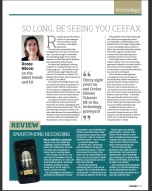
I have to thank a give-away of National Geographic Traveller at Stansted Airport for giving me the idea for my main piece in my latest technology column for The Journalist.

An article on “the end of the guide book” alerted me to Google Authorship – I was astonished that I hadn’t heard about what is potentially a really important development for journalists.

Authorship allows a creator of content to claim ownership of their work by linking blogs and article to their Google+ profile. You might have stumbled upon already when you see a thumbnail and byline in your search results – here’s a screenshot of my entry to illustrate Authorship.

Screen Shot 2013-04-16 at 22

Speaking to SEO experts and online editors, it is clear that most media organisations know about Google Authorship and are beginning to implement it on their sites. But how many individually journalists know about it? Particularly freelancers who could potentially be the big winners from this development.

You can download a PDF of the column which includes this article and a review of infographic apps here. You can access the links that I found useful when writing both articles below.

The Journalist, April / May 2013, Google Authorship

Link your Google+ profile to the content that you create, Google

Authorship – Inside Search Google

Authorship: What and How and Why is it so Important to Google?, State of search

Claim Google Authorship for Your WordPress Website in 3 Easy Steps, Copyblogger

How to Use Google Authorship to Boost SEO and Reduce Piracy, Author Media

Don’t build links, build bubbles… Distilled

Google Authorship Markup: How to get your picture in search results, Kissmetrics

 The Journalist, April / May 2013, Infographics

Infogr.am website, Infogr.am

Picktochart website, Author Media

Inspirational infographics, Information is beautiful

My latest technology column in the Journalist magazine focused on trends for 2013 – you can download a PDF version of it here.

Once again, I am including some of the links that I found useful when writing the column in this blog post.

The Journalist, February / March 2013, 4G

Everything Everywhere speed test, PC Advisor

Ireland should finally get 4G in 2013, Gigaom

4G auction bidders announced, Ofcom

EE field test, IT Pro

Not so fast – testing 4G, BBC News

What does the iPhone 5 offer journalists, BBC College of Journalism

The Journalist, February / March 2013, Trends for 2013

Matter -in-depth science and technology features

Atavist - self-publishing platform

http://www.nuj.org.uk/innerPagenuj.html?docid=871Last month my first technology column was published in the Journalist magazine – you can download it here (December 2012 / January 2013).

I subsequently worked out that it was only my third byline in print this year, showing the extent I have shifted over to online platforms. Perhaps this is why it felt a bit odd not having to link to my research as I would normally do as an online journalist.

I am now looking ahead to the next column and have the nagging thought that the difficulty of linking in print is a real disadvantage with a tech column. As a result, I have decided to start linking to some of the websites I found useful while researching my column via this blog.

Here are some links that relate to one of the articles in my last column.

The Journalist, December 2012/ January 2013, smartphone recording

The Best Voice Recording App for iPhone, Lifehacker

iOS apps reviewed: Voice Memos (no link available for stock app), Audio Memos

The Best Voice Recording App for Android, Lifehacker 

Android apps reviewed: Tape-and-Talk Voice Recorder, Smart Voice Recorder, Voice Recorder (no link available for stock app)

In February I blogged about the beauty of news in its purest form and why it is worthwhile reviewing news from the past. My main point was that when news is processed into documentaries for example after the event, that raw instant reaction and early analysis is lost. Yesterday’s broadcast of the BBC’s 1992 election coverage as live on BBC Parliament hammered this point home. Read the rest of this entry »

Everyone remembers where they were and what they were doing when a big story broke. Whether it is waking up in a Bangkok hotel to find that Michael Jackson had died or hearing about the 7/7 bombings on your radio during your journey to work you are consuming the news in its rawest form: live, rolling news as it happens.

Whilst I love documentaries, packages and films, news in its purest sense does have a beauty. The impact of those first reports is lost with editing and hindsight. You will never recapture that moment again. Read the rest of this entry »

Melting pot or goldfish bowl? BBC exposes engine room to the public gaze – TV & Radio – Media – The Independent.

This is nothing new. It was revealed by the Broadcasting House project manager in Ariel – the BBC’s in-house magazine – about 18 months ago. But it is fantastic news that the BBC has stuck with this part of its plans to promote the openness of the newsroom.

For more on this and other initiatives to move the newsroom back into the community, please see my feature for the Journalist in the February / March 2011 issue. I also blogged about newsroom openness at the time.

Hyperlocal blogs are a great way for student journalists to get some experience of reporting, community management and online publishing. But what do their potential readers think of student-run hyperlocal blogs? Members of a community in Sheffield recently gave student bloggers a very hard time when they attempted to engage with their potential readership.

The problem seems to stem from the fact that there are two universities in Sheffield, plus a very good further education college, and therefore a lot of students working on community-based projects. Not only do you have journalism students working on community-based projects, you have film makers, geography students, law students and nursing students. At any one time there must be hundreds of students making contact with community groups and local online forums.

Now, there are of course some fabulous examples of students who have done fantastic things for a community as part of their course or with a student society. There are law students who have helped to challenge wrongful convictions as part of the Innocence Network and there are many other fantastic examples of where student projects have been a force for good. Read the rest of this entry »

Originally uploaded by littlesaint_uk.

I’ve just returned from a trip to India where I traveled around the southern states of Karnataka and Goa. It’s my third visit to India and each time I have kept up with world news mainly through Indian newspapers like the Times of India and the Hindu.

Having briefly worked on an Indian paper, I am interested in how the media there is affected by the changes to the industry that we have face in Europe. One thing I have noticed is fewer features and original news in Indian papers than previously. This is a shame both for the reader and for India-based journalists, many of whom must be itching to bring hard-hitting stories to their readers’ attention. Read the rest of this entry »

Originally uploaded by MeLicA.

This morning Radio 4′s Today programme hosted a discussion between three successful career women about the existence of a glass ceiling preventing women from progressing in their careers. It was part of former Commons speaker Betty Boothroyd’s stint as guest editor of the show.

The discussion involved Lorraine Heggessey, the first female controller of BBC1, Lucy Neville Rolfe, executive director and a member of the board of Tesco  and Rachel Lomax, former deputy governor of the Bank of England. They agreed that often women need to speak up a bit more and overcome the barriers in their own mind, such as fear of failure.

Heggessey said men are often better at pointing out all the things they can do whereas women are often stuck on what they can’t do. If men do get that voice in their head “they squash it down,” she said. Read the rest of this entry »


Originally uploaded by littlesaint_uk.

Mobile phones have come a long way in just a few years.

I got my first mobile little more than a decade ago and back then even texting was a novelty. Now you can shoot, edit and distribute video and audio on one smartphone. In fact, even professional broadcast journalists are using them to produce their packages.

Smartphones potentially turn us all into broadcast journalists, but in this article for The Journalist magazine I explore how smartphones offer print and online journalists in particular an opportunity to become multimedia reporters.

The key thing is to learn how to use a smart phone to create a quality mobile journalism (MoJo) product. That’s something many journalists, including myself, are still working out. It is a very exciting time.

Turn to pages 12 – 13 to see this feature.

About me

I'm a London-based journalist with more than eleven years’ experience. I have worked as an freelance online journalist for Channel 4 News and the BBC. I have also experience of working on magazines, as a television researcher and of PR. Please see my biography or email me for further information.

Email me

Enter your email address to follow this blog and receive notifications of new posts by email.

Join 17 other followers

rosieniven

Follow

Get every new post delivered to your Inbox.

%d bloggers like this: